Description
Form
climber, perennial, deciduous
Height: Climbs to 15–20 m; kept short by pruning in vineyards
Flower colour
Green
Flowering
May–June
Leaves
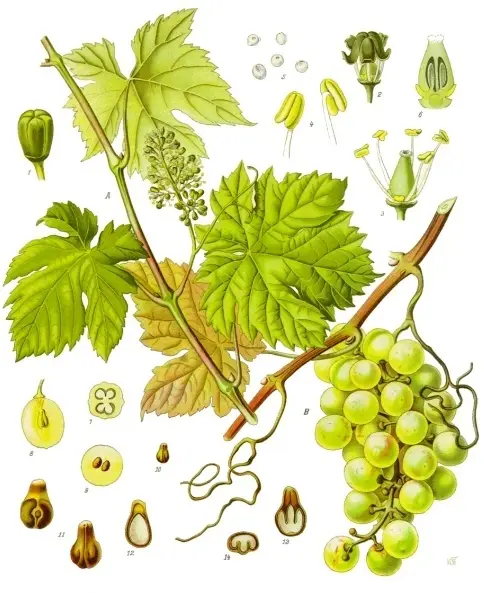
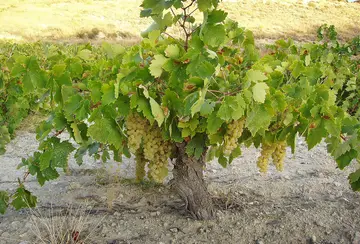
Large, hand-shaped leaves with 3–5 lobes and toothed edges. It climbs with branched tendrils that grow opposite the leaves.
Flowers
Small, greenish, fragrant flowers in clusters; as they open, the petals fall off together like a little cap.
Fruit and seeds
Berries in bunches, ranging from green to purple and black.
Classification
- KingdomPlantae
- PhylumTracheophyta
- ClassMagnoliopsida
- OrderVitales
- FamilyVitaceae
- GenusVitis
- SpeciesVitis vinifera
Native range
According to POWO it is native to southern and central Europe, North Africa, Türkiye, the Caucasus, Iran, Iraq and Central Asia. The wild grapevine (subsp. sylvestris) climbs trees in riverside forests.
IUCN Red List status: Least concern (LC).
Growing conditions
Light
Full sun.
Water
Fairly drought tolerant.
Soil
Free-draining soil; it does well on chalky, stony slopes.
Temperature
Likes hot, dry summers.
Winter pruning is essential for a good crop: grapes form on the current year's shoots.
Culture and history
One of the oldest crops
The grapevine is among the first plants people domesticated. Genetic studies show that the first cultivated vines were grown in western Asia, around Anatolia and the Caucasus.
Stuffed vine leaves
Fresh vine leaves are used to make sarma (stuffed vine leaves) in Turkish and Middle Eastern cooking, and are brined to keep through the winter.
Toxicity
According to ASPCA, grapes and raisins can cause kidney damage in dogs, and even small amounts can be dangerous. A dog that has eaten grapes should be taken to a vet straight away.
In an emergency call your local poison centre; for pets, contact a vet straight away. See also: plants and pets.
Look-alikes
- American grapes (Vitis labrusca and others): Used as rootstocks resistant to phylloxera; the musky "fox grape" flavour comes from them.
Questions
Are grapes toxic to dogs?
Yes. According to ASPCA, grapes and raisins can cause kidney damage in dogs.
Where was the grapevine first domesticated?
Genetic studies point to western Asia, around Anatolia and the Caucasus.
Grapevine: when does it flower?
In spring and summer: May–June. Months are for temperate northern-hemisphere climates and shift with altitude and weather.
Grapevine: how do you grow it?
Light: Full sun. Water: Fairly drought tolerant. Soil: Free-draining soil; it does well on chalky, stony slopes. Temperature: Likes hot, dry summers.
Grapevine: when and how do you prune it?
Winter pruning is essential for a good crop: grapes form on the current year's shoots.
Grapevine: what is its scientific name?
Vitis vinifera L., in the genus Vitis and the family Vitaceae.
Sources
- Wikipedia: Vitis vinifera
- ASPCA: People Foods to Avoid Feeding Your Pets
- World Flora Online
- Plants of the World Online (Kew) · native range (WCVP)
- GBIF · classification
- Wikidata
Checked: 2026-11-17. Spotted a mistake? Tell us.