Description
Form
succulent, perennial, evergreen
Height: 5–10 cm (rosette 10 cm across)
Flower colour
PinkYellow
Flowering
April–June
Habitat
Leaves
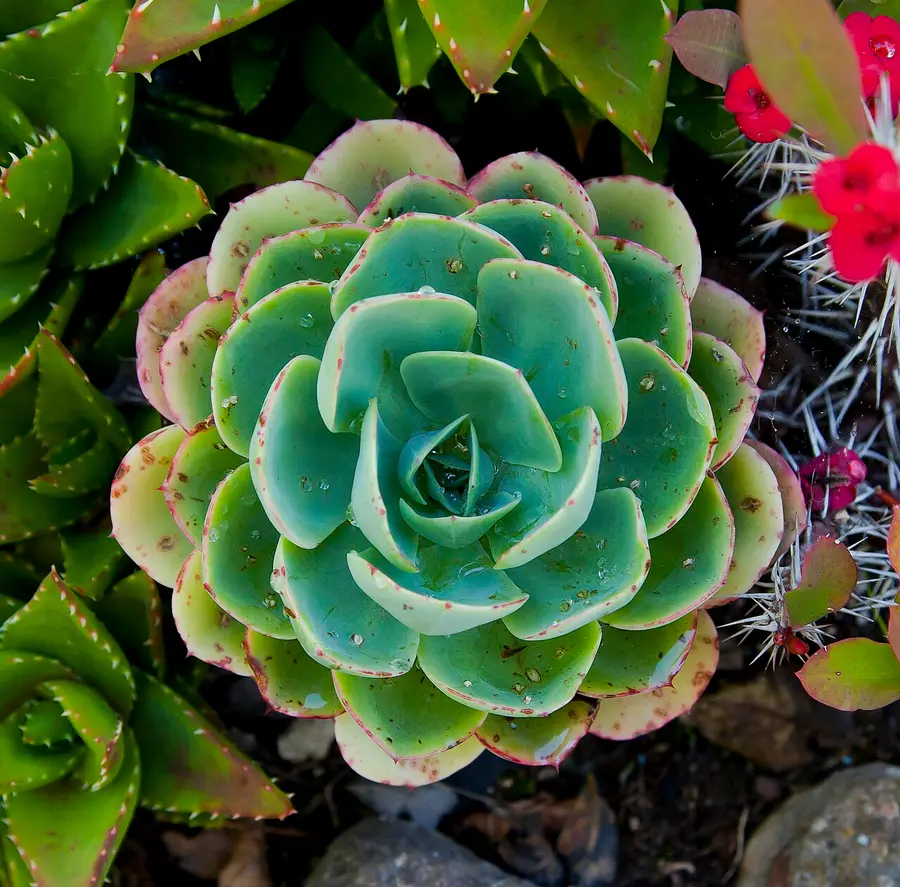
Thick, fleshy, spoon-shaped, silvery blue-green leaves coated in a white, powdery wax that rubs off when touched.
Flowers
Pink, bell-shaped flowers with yellow tips on pinkish-red stalks rising from the rosette.
Classification
- KingdomPlantae
- PhylumTracheophyta
- ClassMagnoliopsida
- OrderSaxifragales
- FamilyCrassulaceae
- GenusEcheveria
- SpeciesEcheveria elegans
Native range
According to POWO it is native to the south-western, north-eastern and Gulf regions of Mexico, in mountainous and rocky places.
Care
Light
Bright light with a few hours of direct sun. In low light the rosette opens out and stretches.
Water
Little. Water when the soil is completely dry; in winter once a month or not at all.
Soil
Cactus and succulent compost, or a very free-draining mix with added grit or perlite.
Temperature
Tolerates brief, light cold; suffers in wet, cold winters.
Propagate from offsets or by laying a single leaf on the soil.
Toxicity
ASPCA lists Echeveria elegans as non-toxic to cats, dogs and horses.
In an emergency call your local poison centre; for pets, contact a vet straight away. See also: plants and pets.
Look-alikes
- Common houseleek (Sempervivum): Forms similar rosettes, but the leaf tips are pointed and it is much hardier to cold. Compare side by side →
- Common houseleek (Sempervivum tectorum): Also a succulent with fleshy leaves in tight rosettes, but its leaves are pointed with finely hairy edges, often red-tipped, and have no white bloom. Its starry pink-purple flowers open in summer and the flowering rosette then dies. Echeveria leaves are spoon-shaped and powdery, and its flowers are bell-shaped. Compare side by side →
Questions
Why is my echeveria getting leggy?
It is not getting enough light. The rosette opens and the stem stretches; move it somewhere sunnier.
Mexican snowball: when does it flower?
In spring and summer: April–June. Months are for temperate northern-hemisphere climates and shift with altitude and weather.
Mexican snowball: how do you care for it?
Light: Bright light with a few hours of direct sun. In low light the rosette opens out and stretches. Water: Little. Water when the soil is completely dry; in winter once a month or not at all. Soil: Cactus and succulent compost, or a very free-draining mix with added grit or perlite. Temperature: Tolerates brief, light cold; suffers in wet, cold winters.
Mexican snowball: how do you propagate it?
Propagate from offsets or by laying a single leaf on the soil.
Mexican snowball: is it toxic to cats and dogs?
Non-toxic to cats and dogs. Non-toxic to pets (ASPCA).
Mexican snowball: what is its scientific name?
Echeveria elegans Rose, in the genus Echeveria and the family Crassulaceae.
Sources
- Wikipedia: Echeveria elegans
- World Flora Online
- Plants of the World Online (Kew) · native range (WCVP)
- GBIF · classification
- Wikidata
- ASPCA Animal Poison Control: Hens and Chickens (Echeveria elegans)
Checked: 2026-11-16. Spotted a mistake? Tell us.