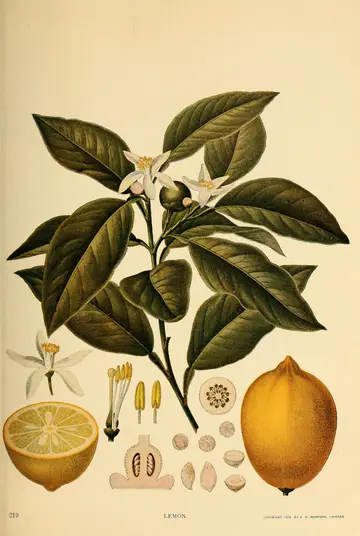
Description
Form
shrub or small tree, perennial, evergreen
Flowering
No reliable data in the sources.
Habitat
Fruit and seeds
Fruits usually 12–15 cm long, longer than wide, with a thick, hard, fragrant, rough and bumpy rind.
Classification
- KingdomPlantae
- PhylumTracheophyta
- ClassMagnoliopsida
- OrderSapindales
- FamilyRutaceae
- GenusCitrus
- SpeciesCitrus medica
Native range
According to POWO it is native to Assam, Bangladesh, the eastern and western Himalaya, Nepal and Myanmar. According to the Turkish Wikipedia it is now grown mostly around the Mediterranean, in parts of India and in South and Central America.
IUCN Red List status: Least concern (LC).
Growing conditions
According to the Turkish Wikipedia it grows slowly and starts fruiting at three years old.
Culture and history
Where "citrus" comes from
According to Wikipedia the fruit's name comes from the Latin citrus, which also gave the genus its name. The epithet medica comes from Media, the land of the Medes, where it was once believed to originate.
False friends
According to Wikipedia the English "citron" and the French "citron" are false friends: in French citron means lemon, and the citron is called cédrat.
Look-alikes
- Lemon (Citrus × limon): A hybrid of bitter orange and citron. Its fruit is oval, yellow and pointed; citron fruit is larger, with a very thick, hard and bumpy rind. Compare side by side →
Questions
Is citron the same as lemon?
No. Citron (Citrus medica) is one of the original, non-hybrid citrus species; the lemon is a hybrid of bitter orange and citron. Citron fruit is larger than a lemon, with a very thick, rough rind.
Citron: what is its scientific name?
Citrus medica L., in the genus Citrus and the family Rutaceae.
Sources
- Wikipedia: Citron
- Plants of the World Online (Kew) · native range (WCVP)
- GBIF · classification
- Wikidata
Checked: 2026-11-24. Spotted a mistake? Tell us.