Description
Form
shrub, perennial, deciduous
Height: Up to 3 m
Flower colour
BluePinkPurpleWhite
Flowering
June–September
Habitat
Leaves
Opposite, round to elliptic, pointed leaves up to 15 cm, usually toothed.
Flowers
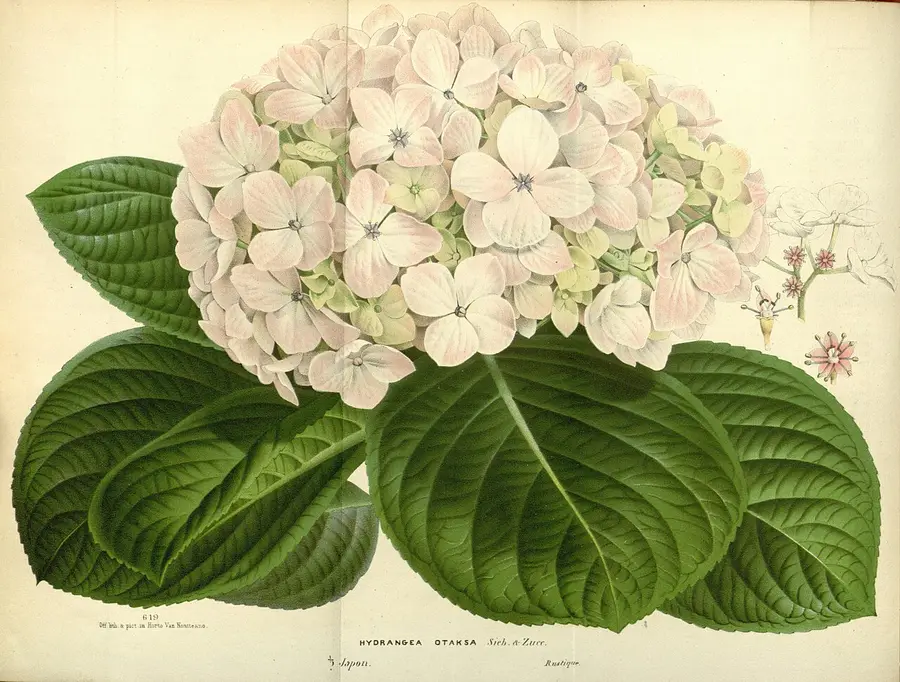
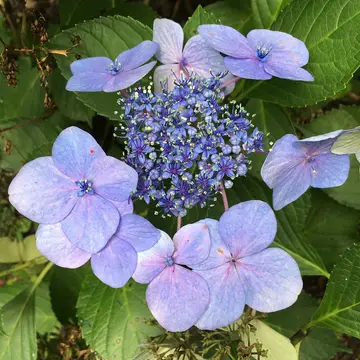
In the wild plant, flat clusters of many small fertile flowers ringed by a few large, showy, mostly sterile ones. In most of the 500-plus garden varieties the whole cluster is made of large sterile flowers and forms a ball; lacecap varieties keep the flat cluster. White varieties do not change colour.
Fruit and seeds
Small, roundish capsules.
Classification
- KingdomPlantae
- PhylumTracheophyta
- ClassMagnoliopsida
- OrderCornales
- FamilyHydrangeaceae
- GenusHydrangea
- SpeciesHydrangea macrophylla
Native range
According to POWO its native range is Japan and the Volcano Islands, where it grows in coastal habitats from Honshu southwards. It is a common ornamental in temperate regions and has become invasive in the Azores and Madeira.
Growing conditions
Light
Partial shade; protect from midday sun in hot regions.
Water
Plenty; needs constantly moist soil. Its name comes from the Greek for "water" and "vessel".
Soil
Humus-rich, moist soil; blue flowers need acid soil.
Temperature
Likes a mild climate; hard frost damages the flower buds.
It flowers on the previous year's wood, so hard autumn pruning means fewer flowers the next year.
Culture and history
A colour-changing flower
The blue colour comes from aluminium in the soil combining with the anthocyanin pigment in the flower. Aluminium is only available to the plant in acid soil, so hydrangeas on limy soil stay pink.
Toxicity
Hydrangeas contain cyanogenic glycosides. ASPCA lists hydrangea (entry under Hydrangea arborescens) as toxic to cats, dogs and horses; signs are vomiting, depression and diarrhoea. Cyanide poisoning is rare.
In an emergency call your local poison centre; for pets, contact a vet straight away. See also: plants and pets.
Look-alikes
- Guelder-rose and snowball tree (Viburnum opulus): Its flower clusters also have small fertile flowers in the middle ringed by large, white sterile ones, and in the snowball form all flowers are sterile and the cluster is round. But its leaves are three-lobed like a maple's and it bears glossy red berries. Hydrangea leaves are unlobed, and the flowers can be blue or pink depending on the soil. Compare side by side →
Questions
Why are hydrangeas blue or pink?
In acid soil containing aluminium the flowers are blue; in limy soil they are pink. Most hydrangeas on the acid soils of Türkiye's Black Sea coast are blue.
Bigleaf hydrangea: when does it flower?
In summer and autumn: June–September. Months are for temperate northern-hemisphere climates and shift with altitude and weather.
Bigleaf hydrangea: how do you grow it?
Light: Partial shade; protect from midday sun in hot regions. Water: Plenty; needs constantly moist soil. Its name comes from the Greek for "water" and "vessel". Soil: Humus-rich, moist soil; blue flowers need acid soil. Temperature: Likes a mild climate; hard frost damages the flower buds.
Bigleaf hydrangea: when and how do you prune it?
It flowers on the previous year's wood, so hard autumn pruning means fewer flowers the next year.
Bigleaf hydrangea: is it toxic to cats and dogs?
Toxic to cats and dogs. Cyanogenic glycosides: vomiting, diarrhoea.
Bigleaf hydrangea: what is its scientific name?
Hydrangea macrophylla (Thunb.) Ser., in the genus Hydrangea and the family Hydrangeaceae.
Sources
- Wikipedia: Hydrangea macrophylla
- World Flora Online
- Plants of the World Online (Kew) · native range (WCVP)
- GBIF · classification
- Wikidata
- ASPCA Animal Poison Control: Hydrangea (kayıt: Hydrangea arborescens)
Checked: 2026-11-16. Spotted a mistake? Tell us.