Telling them apart
Lenten rose vs Monkshood
Lenten rose (Helleborus orientalis) and Monkshood (Aconitum napellus) look similar enough to be confused. Both belong to the same family, Ranunculaceae (buttercup family).
CautionLenten rose and Monkshood are poisonous to people. Never pick or eat a wild plant unless you are certain of its identity. If poisoning is suspected, call your local poison centre or emergency number.
Image wanted. A licensed image will be added when found.
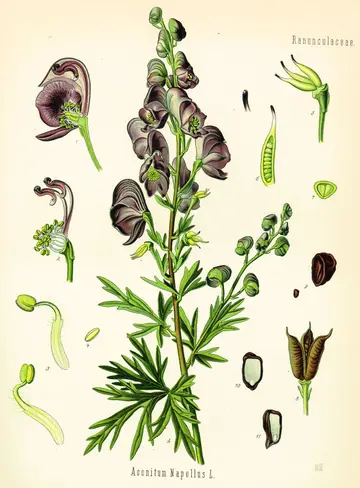
How to tell them apart
- Monkshood: Same family and also very poisonous, but it flowers in summer with hooded, deep blue-purple flowers. Lenten rose has nodding, cup-shaped flowers in late winter.
Side by side
| Lenten rose | Monkshood | |
|---|---|---|
| Scientific name | Helleborus orientalis | Aconitum napellus |
| Family | Ranunculaceae (buttercup family) | Ranunculaceae (buttercup family) |
| Form | herbaceous, perennial, evergreen | herb, perennial |
| Height | 28–45 cm | 0.5–1.5 m |
| Flower colour | White, Pink, Purple, Green | Blue, Purple |
| Origin | Greece, Türkiye and the Caucasus | Western and central European mountains |
| Toxicity | People: toxic | People: toxic · Cats: toxic · Dogs: toxic |
| Flowering | ||
| Leaves | Glossy green, leathery, evergreen, hand-shaped leaves of seven to nine leaflets with toothed edges. | Deeply divided, hand-shaped leaves. |
| Flowers | Nodding, cup-shaped flowers in groups of one to four on thick stems above the leaves, with yellow stamens. Cultivated varieties may be white, green, pink, maroon, purple or spotted. | Deep blue-purple flowers in an upright spike, the upper petal closed over like a helmet or a monk's hood. |
| Fruit and seeds | — | A three-part dry fruit (follicles). |
All pairs: look-alike plants · Full pages: Lenten rose, Monkshood