Telling them apart
Crown imperial vs Garden tulip
Crown imperial (Fritillaria imperialis) and Garden tulip (Tulipa gesneriana) look similar enough to be confused. Both belong to the same family, Liliaceae (lily family).
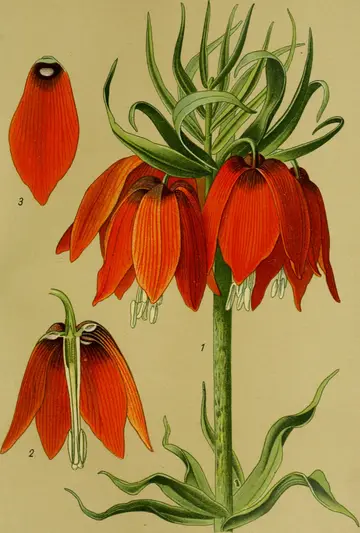
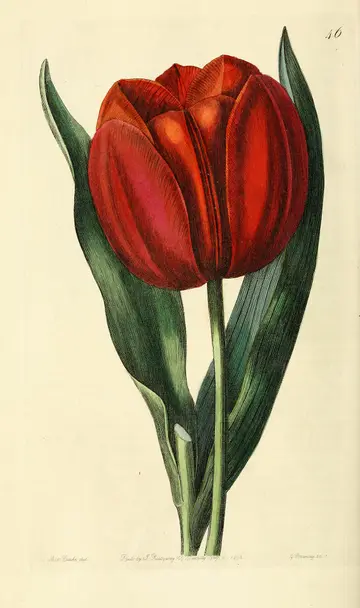
How to tell them apart
- Garden tulip: Despite the Turkish name ("upside-down tulip"), tulip flowers face upwards and have no leafy crown.
Side by side
| Crown imperial | Garden tulip | |
|---|---|---|
| Scientific name | Fritillaria imperialis | Tulipa gesneriana |
| Family | Liliaceae (lily family) | Liliaceae (lily family) |
| Form | herbaceous, perennial | herbaceous bulb, perennial |
| Height | 60–100 cm | 20–70 cm (by cultivar) |
| Flower colour | Orange, Red, Yellow | Red, Yellow, Pink, Purple, White, Orange |
| Origin | Türkiye to the western Himalaya | Garden origin from wild tulips of Central Asia and Anatolia |
| Toxicity | — | People: mildly toxic / irritant · Cats: toxic · Dogs: toxic |
| Flowering | ||
| Leaves | Glossy, lance-shaped leaves in whorls on the lower half of the stem. Above the flowers sits a "crown" of small leaves. | Two to six broad, bluish-green leaves at the base of the stem. |
| Flowers | At the top of the stem, 3–8 bell-shaped flowers hang beneath the leafy crown. Wild plants are mostly orange-red; garden forms can be yellow or red. A shining drop of nectar sits at the base of each petal. The plant gives off a sharp, foxy smell. | A single cup-shaped flower of six tepals on each stem, in almost every colour except true blue. |
| Fruit and seeds | An upright, six-angled, winged capsule. | A three-sided capsule with flat seeds; garden plants are propagated from bulbs. |
All pairs: look-alike plants · Full pages: Crown imperial, Garden tulip