Telling them apart
Common bean vs Soybean
Common bean (Phaseolus vulgaris) and Soybean (Glycine max) look similar enough to be confused. Both belong to the same family, Fabaceae (legume family).
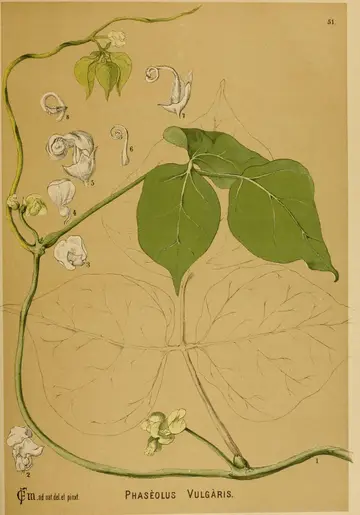
Image wanted. A licensed image will be added when found.
How to tell them apart
- Common bean: Also a legume with three leaflets, but its pods are long and smooth and the plant often climbs. Soybean pods are short (3–8 cm) and hairy.
Side by side
| Common bean | Soybean | |
|---|---|---|
| Scientific name | Phaseolus vulgaris | Glycine max |
| Family | Fabaceae (legume family) | Fabaceae (legume family) |
| Form | climber, annual | herbaceous, annual |
| Height | Climbing varieties 2–3 m, bush varieties 20–60 cm | 50–125 cm |
| Flower colour | White, Pink, Purple | White, Pink, Purple |
| Origin | Central and South America | East Asia |
| Toxicity | — | — |
| Flowering | — | — |
| Leaves | Compound leaves of three broad, pointed leaflets. | The first true leaves are a pair of simple blades; later leaves have three leaflets, each 6–15 cm long and 2–7 cm wide. |
| Flowers | Butterfly-shaped flowers typical of the legume family, white, pink or purple. | Inconspicuous, self-fertile white, pink or purple flowers in the leaf axils. |
| Fruit and seeds | A long pod. Young pods are eaten as green beans and the ripe seeds as dried beans. | Hairy pods 3–8 cm long in clusters of three to five, each usually holding two to four seeds. |
All pairs: look-alike plants · Full pages: Common bean, Soybean