Telling them apart
Black locust vs Silver wattle
Black locust (Robinia pseudoacacia) and Silver wattle (Acacia dealbata) look similar enough to be confused. Both belong to the same family, Fabaceae (legume family).
CautionBlack locust is poisonous to people. Never pick or eat a wild plant unless you are certain of its identity. If poisoning is suspected, call your local poison centre or emergency number.
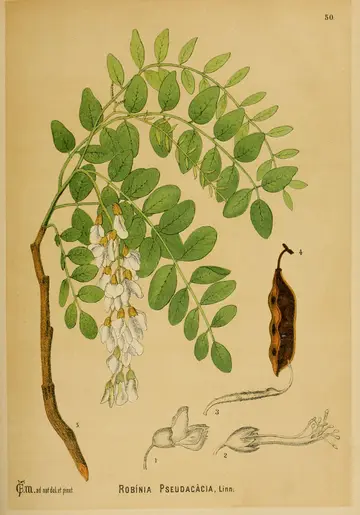
Image wanted. A licensed image will be added when found.
How to tell them apart
- Black locust: The tree called "akasya" in Türkiye; its flowers are white in hanging clusters and its leaflets much larger.
Side by side
| Black locust | Silver wattle | |
|---|---|---|
| Scientific name | Robinia pseudoacacia | Acacia dealbata |
| Family | Fabaceae (legume family) | Fabaceae (legume family) |
| Form | tree, perennial, deciduous | tree, perennial, evergreen |
| Height | 12–30 m | Usually up to 15 m; 30 m in the wild |
| Flower colour | White | Yellow |
| Origin | Eastern United States | South-eastern Australia |
| Toxicity | People: toxic | — |
| Flowering | ||
| Leaves | Compound leaves 15–36 cm long with 9–19 oval leaflets. A pair of stiff thorns sits at the base of each leaf. | Twice-pinnate leaves with 6–30 pairs of side branches, each carrying many tiny, silvery-bluish leaflets. |
| Flowers | White, pea-like, very fragrant flowers in hanging clusters; an important nectar source for bees. | Bright yellow, round pompom heads, each made of 13–42 tiny flowers, in fragrant clusters. |
| Fruit and seeds | Flat, brown pods 5–10 cm long that stay on the tree through winter. | Straight or slightly curved, flat, bluish or purplish pods with a white bloom. |
All pairs: look-alike plants · Full pages: Black locust, Silver wattle