Telling them apart
Aloe vera vs Century plant
Aloe vera (Aloe vera) and Century plant (Agave americana) look similar enough to be confused. They belong to different families: Asphodelaceae (asphodel family) and Asparagaceae (asparagus family).
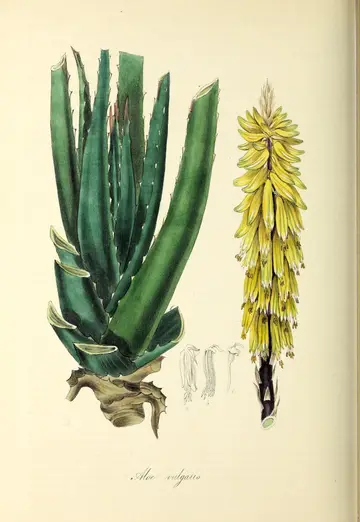
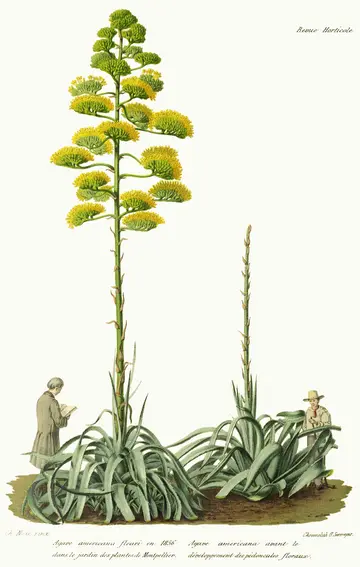
How to tell them apart
- Century plant: Much larger, with stiff leaves ending in a sharp spine and no gel inside.
- Aloe vera: Much smaller, with soft, gel-filled leaves and no hard tip spine. Agave belongs to a different family.
Side by side
| Aloe vera | Century plant | |
|---|---|---|
| Scientific name | Aloe vera | Agave americana |
| Family | Asphodelaceae (asphodel family) | Asparagaceae (asparagus family) |
| Form | succulent, perennial, evergreen | succulent, perennial, evergreen |
| Height | 60–100 cm | Rosette 1–2 m; flowering stalk 5–8 m |
| Flower colour | Yellow | Yellow |
| Origin | Arabian Peninsula (disputed) | Mexico and the south-western United States |
| Toxicity | People: mildly toxic / irritant · Cats: toxic · Dogs: toxic | People: mildly toxic / irritant |
| Flowering | — | |
| Leaves | Thick, fleshy, lance-shaped leaves in a rosette, grey-green with small teeth along the edges. | Thick leaves 1–2 m long, grey-blue or edged with yellow; the margins carry hooked teeth and each leaf ends in a very hard, sharp spine. |
| Flowers | Tubular yellow flowers hang from the tip of a stalk 60–90 cm tall rising from the centre of the rosette; houseplants rarely flower. | When the plant is 10–30 years old, a giant, tree-like branched stalk rises from the centre of the rosette, with clusters of yellow flowers at the branch tips. |
| Fruit and seeds | A small capsule. | Capsules; the plant can also produce small plantlets on the flowering stalk. |
All pairs: look-alike plants · Full pages: Aloe vera, Century plant