
Description
Form
herbaceous, perennial
Height: 0.5–1.5 m
Flower colour
Green
Flowering
June–September
Leaves
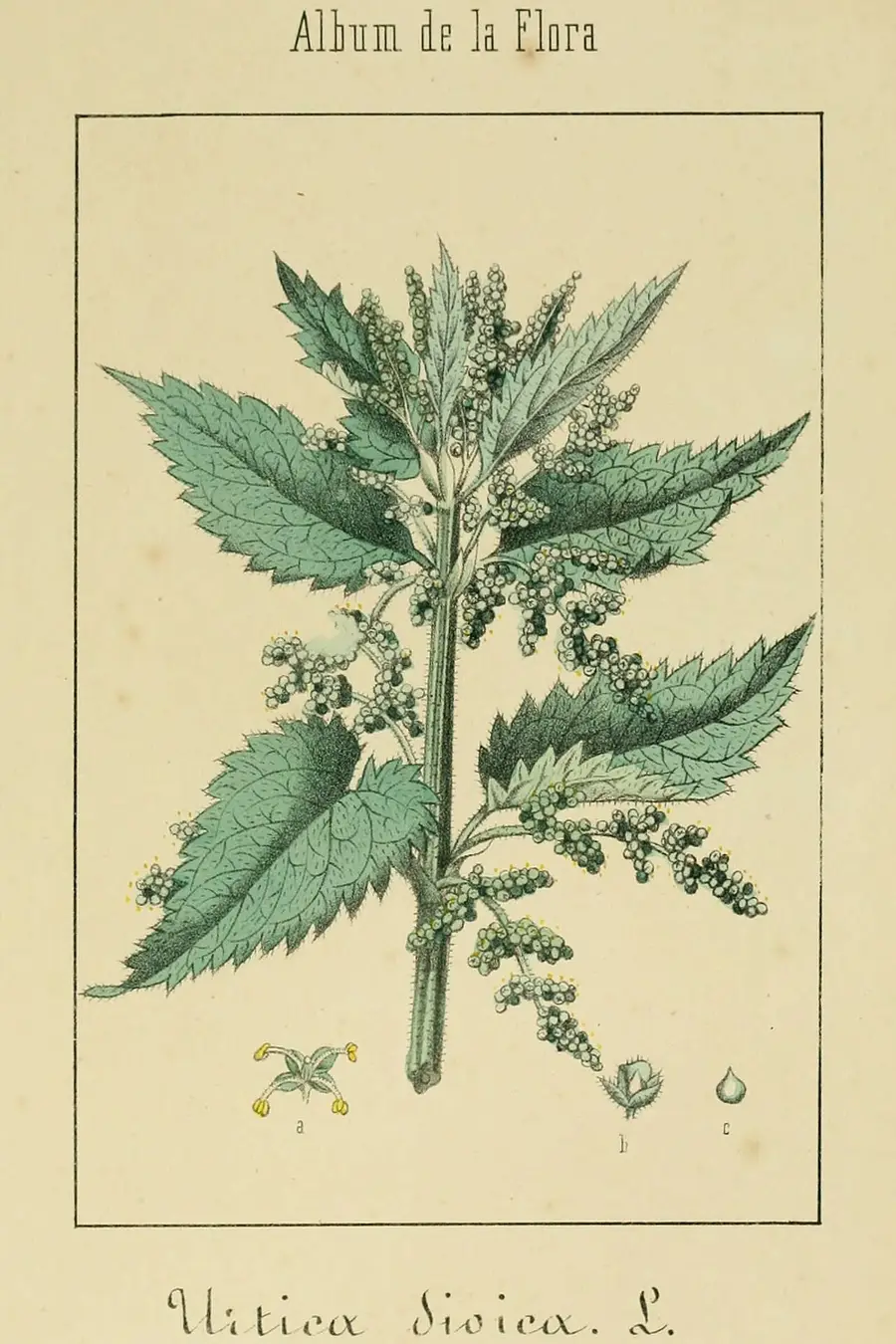
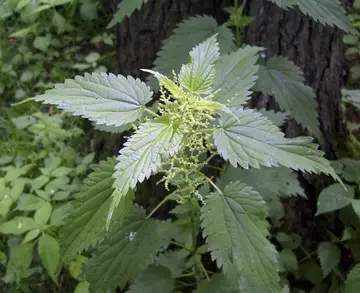
Opposite, heart-shaped, coarsely toothed leaves. Leaves and stems are covered in fine hairs filled with a stinging fluid, which break at a touch.
Flowers
Tiny greenish flowers in thread-like clusters hanging from the leaf axils. Male and female flowers are mostly on separate plants ("dioica" refers to this).
Fruit and seeds
Very small, one-seeded dry fruits.

Classification
- KingdomPlantae
- PhylumTracheophyta
- ClassMagnoliopsida
- OrderRosales
- FamilyUrticaceae
- GenusUrtica
- SpeciesUrtica dioica
Native range
According to POWO it is native throughout Europe, North Africa, Türkiye and a vast area from western and central Asia to Siberia, China and Japan. People have carried it to many parts of the Americas, South Africa and Australia.
IUCN Red List status: Least concern (LC).
Culture and history
A plant for butterflies
The caterpillars of species such as the red admiral, small tortoiseshell and peacock butterfly feed on nettle leaves. A patch of nettles left in a corner of the garden gives these butterflies a home.
Nettle cloth
For centuries nettle stem fibres were woven like linen into cloth in Europe.
Toxicity
The tips of the stinging hairs break at a touch and inject substances such as histamine, acetylcholine and formic acid into the skin. The result is burning, itching and welts lasting a few hours, sometimes a day. Although nettle is widely known as a food, this atlas gives no advice on picking or eating wild plants.
In an emergency call your local poison centre; for pets, contact a vet straight away. See also: plants and pets.
Look-alikes
- Dead-nettles (Lamium species): Their leaves look very like nettle but have no stinging hairs; their stems are square and they bear conspicuous white, pink or purple lipped flowers.
Questions
Why do nettles sting?
The tips of the fine hairs on the leaves and stems break at a touch and inject substances such as histamine, acetylcholine and formic acid into the skin. The burning and itching usually pass within a few hours.
Where do nettles grow?
On nitrogen-rich, damp soil: around villages and barns, at garden edges, along streams and in forest clearings.
Stinging nettle: when does it flower?
In summer and autumn: June–September. Months are for temperate northern-hemisphere climates and shift with altitude and weather.
Stinging nettle: what is its scientific name?
Urtica dioica L., in the genus Urtica and the family Urticaceae.
Read more on OkButWhy
Sources
- Wikipedia: Urtica dioica
- Plants of the World Online (Kew) · native range (WCVP)
- GBIF · classification
- Wikidata
Checked: 2026-11-17. Spotted a mistake? Tell us.