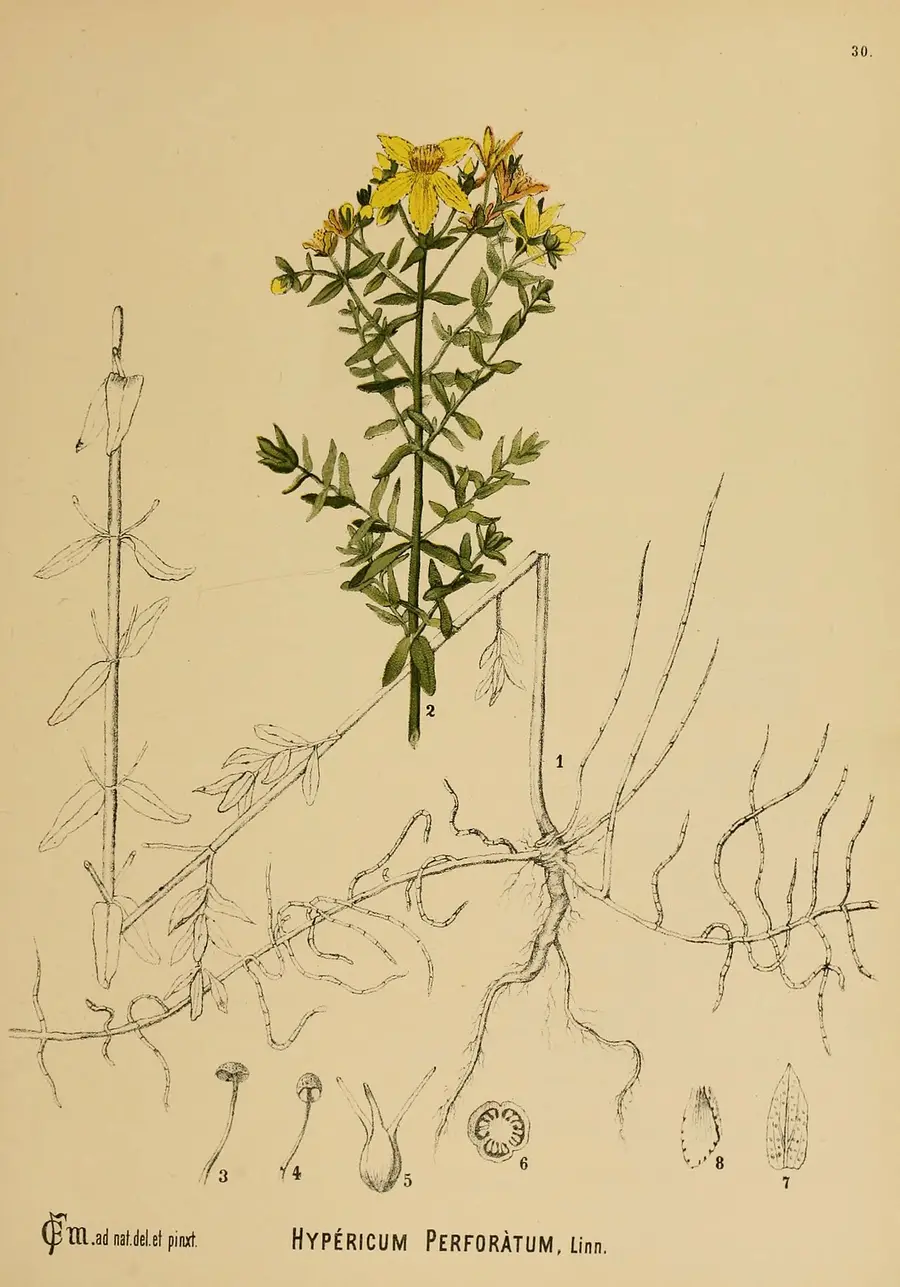

Description
Form
herb, perennial
Height: 30–80 cm
Flower colour
Yellow
Flowering
June–August
Habitat
Leaves
Small, opposite, oval leaves that look perforated against the light because of translucent oil glands ("perforatum").
Flowers
Five-petalled, yellow, star-shaped flowers with black dots on the petal edges; crushed, they leave a reddish stain.
Fruit and seeds
A small capsule.
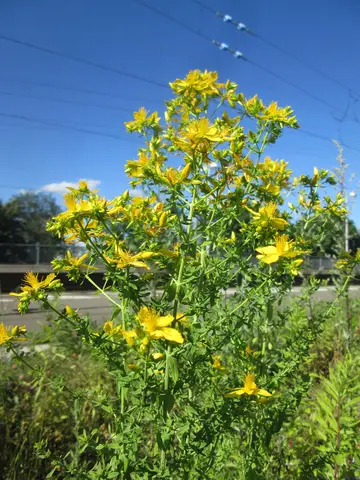

Classification
- KingdomPlantae
- PhylumTracheophyta
- ClassMagnoliopsida
- OrderMalpighiales
- FamilyHypericaceae
- GenusHypericum
- SpeciesHypericum perforatum
Native range
According to POWO it is native to most of Europe, North Africa, Türkiye, Central Asia and Asia as far as China. It is an invasive weed in North America and Australia.
Culture and history
The name
It traditionally flowers around St John's Day (24 June), which gave it its common name.
Toxicity
It contains hypericin. ASPCA lists photosensitisation in cats, dogs and horses (skin inflammation that worsens in sunlight, with sores and discharge); the problem is well known in grazing livestock. Sun sensitivity has also been reported in people, and products made from the plant are known to interact with many medicines, so they should not be used without asking a doctor.
In an emergency call your local poison centre; for pets, contact a vet straight away. See also: plants and pets.
Questions
Is St John's wort toxic to animals?
ASPCA lists it as toxic to cats, dogs and horses because its hypericin makes the skin sensitive to sunlight.
St John's wort: when does it flower?
In summer: June–August. Months are for temperate northern-hemisphere climates and shift with altitude and weather.
St John's wort: what is its scientific name?
Hypericum perforatum L., in the genus Hypericum and the family Hypericaceae.
Sources
- Wikipedia: Hypericum perforatum
- World Flora Online
- Plants of the World Online (Kew) · native range (WCVP)
- GBIF · classification
- Wikidata
- ASPCA Animal Poison Control: St. John's Wort (Hypericum perforatum)
Checked: 2026-11-16. Spotted a mistake? Tell us.