Description
Form
succulent, perennial, evergreen
Height: Up to 1 m after many years; 40–80 cm across
Flower colour
Yellow
Flowering
June–August
Leaves
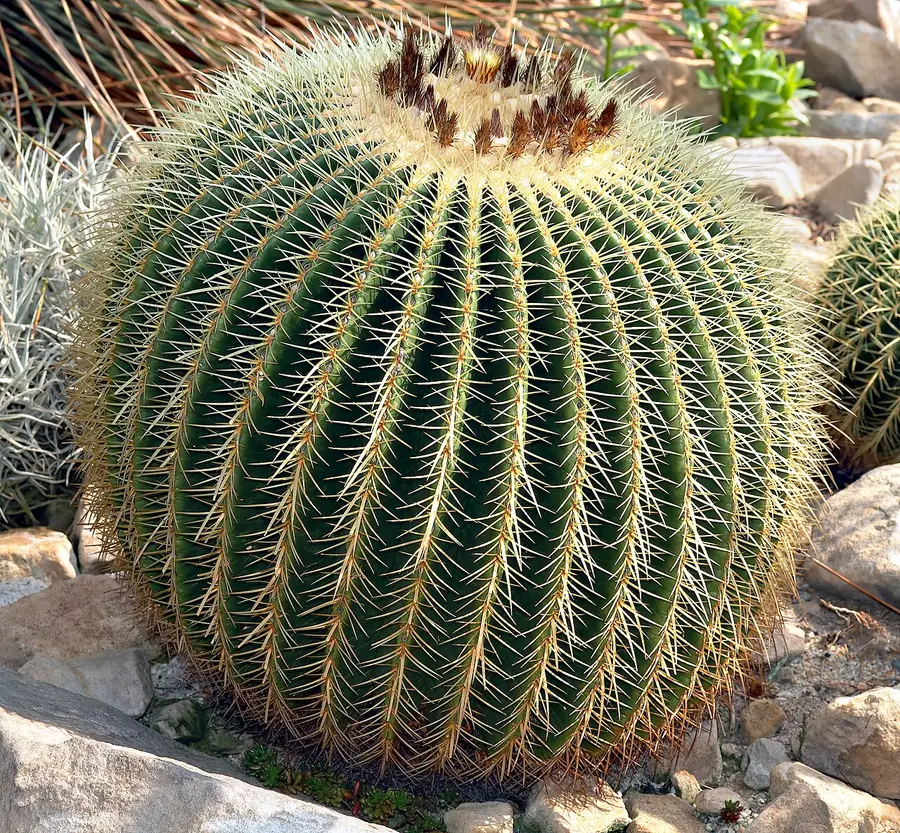
No leaves. The green stem has 21–35 prominent ribs lined with stiff, golden-yellow spines.
Flowers
Only after many years do mature plants bear yellow flowers 4–6 cm across in the woolly crown; each flower stays open for about three days.
Fruit and seeds
A small, woolly fruit.
Classification
- KingdomPlantae
- PhylumTracheophyta
- ClassMagnoliopsida
- OrderCaryophyllales
- FamilyCactaceae
- GenusKroenleinia
- SpeciesKroenleinia grusonii
Native range
According to POWO its native range is north-eastern Mexico, where it grows on sunny volcanic slopes up to about 1,400 m in the states of Querétaro and Hidalgo.
IUCN Red List status: Endangered (EN) (assessed 2013).
Care
Light
Full sun.
Water
Little. Water when the soil is completely dry; in winter once a month or not at all.
Soil
Cactus and succulent compost, or a very free-draining mix with added grit or perlite.
Temperature
Not frost hardy; best kept dry and cool (8–12 °C) in winter.
Culture and history
The name
The species was described in 1891 and named after Hermann Gruson, an industrialist and cactus collector. Long placed in Echinocactus, it was moved to its own genus, Kroenleinia, in 2014. Not all authorities accept this change.
Look-alikes
- Parodia leninghausii: Also sold as "golden ball"; it comes from Brazil and Paraguay, has finer, softer spines and becomes column-shaped with age.
Questions
Is the golden barrel cactus rare?
Although very common in pots, it is rare in the wild: the IUCN Red List assesses it as Endangered (EN). Plants on sale are nursery-grown.
Golden barrel cactus: when does it flower?
In summer: June–August. Months are for temperate northern-hemisphere climates and shift with altitude and weather.
Golden barrel cactus: how do you care for it?
Light: Full sun. Water: Little. Water when the soil is completely dry; in winter once a month or not at all. Soil: Cactus and succulent compost, or a very free-draining mix with added grit or perlite. Temperature: Not frost hardy; best kept dry and cool (8–12 °C) in winter.
Golden barrel cactus: what is its scientific name?
Kroenleinia grusonii (Hildm.) Lodé, in the genus Kroenleinia and the family Cactaceae.
Sources
- Wikipedia: Echinocactus grusonii
- World Flora Online
- Plants of the World Online (Kew) · native range (WCVP)
- GBIF · classification
- Wikidata
- Wikipedia
- Wikipedia: Kroenleinia
Checked: 2026-11-16. Spotted a mistake? Tell us.