Description
Form
herb, biennial
Height: 1–2 m
Flower colour
PurplePinkWhite
Flowering
June–July
Habitat
Leaves
In the first year a rosette of large, hairy leaves forms close to the ground; the flower spike appears in the second year.
Flowers
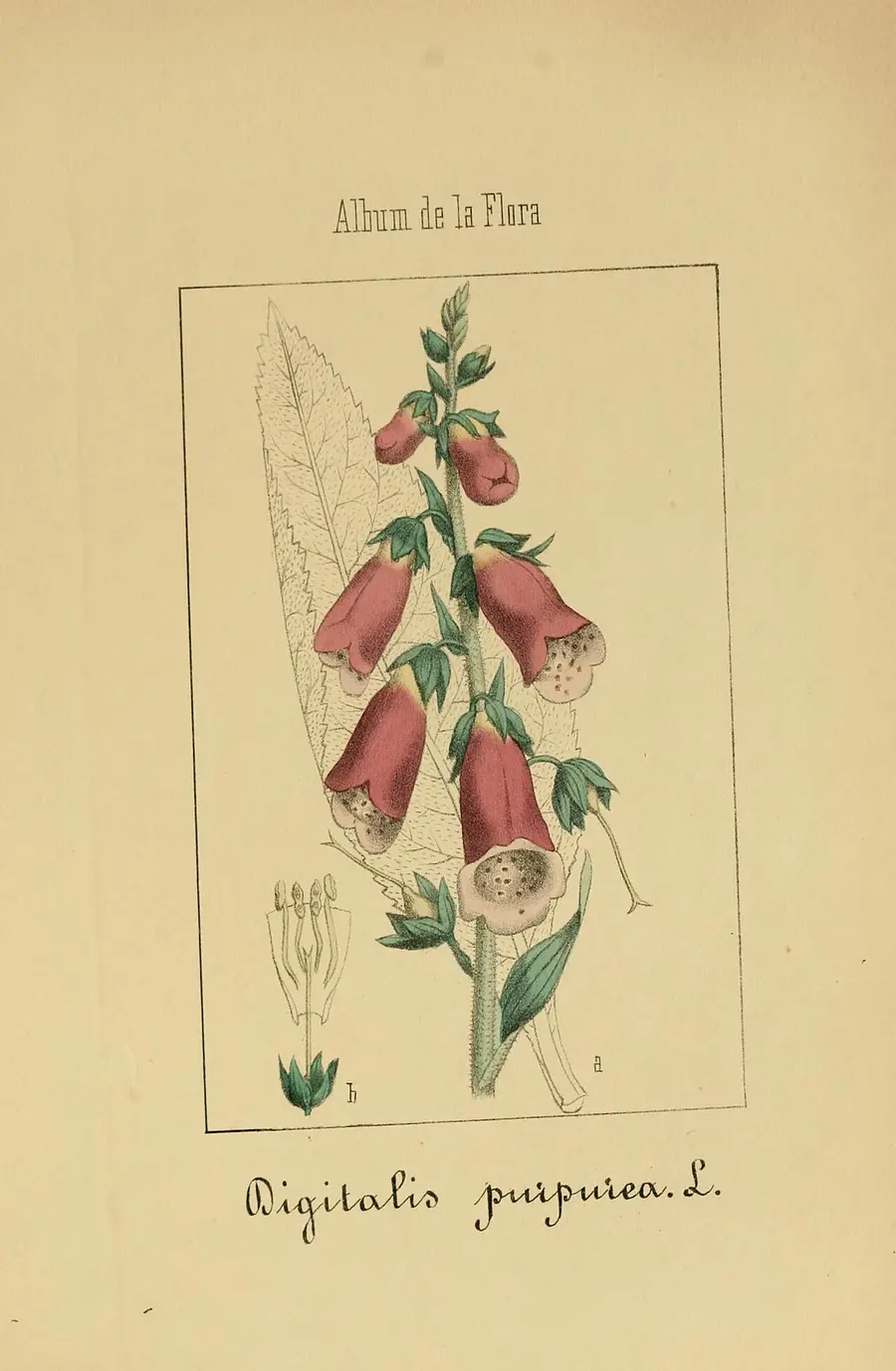
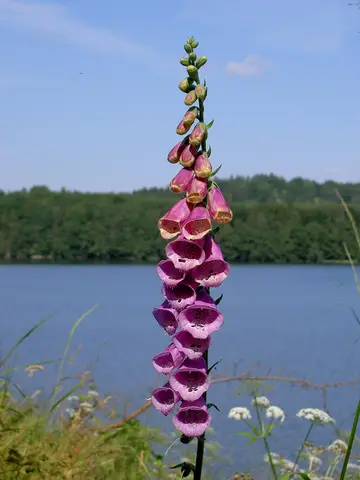
Drooping, tubular purple-pink (sometimes white) flowers along one side of a tall spike, spotted inside.
Fruit and seeds
A capsule with many tiny seeds.
Classification
- KingdomPlantae
- PhylumTracheophyta
- ClassMagnoliopsida
- OrderLamiales
- FamilyPlantaginaceae
- GenusDigitalis
- SpeciesDigitalis purpurea
Native range
According to POWO it is native to western and central Europe (Britain, Ireland, France, Spain, Portugal, Belgium, Germany, Czechia-Slovakia, Sweden), Corsica, Sardinia and Morocco.
Culture and history
In the history of medicine
The cardiac glycosides of foxglove were studied in the 18th century by the English physician William Withering and became important in the history of heart medicine. That does not mean the plant itself can be used: the effective and the lethal amounts are very close.
Toxicity
All parts contain cardiac glycosides (digitoxin and others). ASPCA lists signs in pets as heart rhythm disturbances, vomiting, diarrhoea, weakness, heart failure and death; people suffer similar effects. Poisonings have been reported after its leaves were mistaken for those of comfrey (Symphytum). Never pick or eat a wild plant unless you are certain what it is. If poisoning is suspected, call your local poison centre or emergency number at once.
In an emergency call your local poison centre; for pets, contact a vet straight away. See also: plants and pets.
Look-alikes
- Comfrey (Symphytum officinale): Before flowering, the hairy leaf rosette of foxglove looks very like comfrey; the confusion has caused poisonings.
Questions
Is foxglove poisonous?
Yes, highly. Every part contains cardiac glycosides and can be fatal to people and pets.
Foxglove: when does it flower?
In summer: June–July. Months are for temperate northern-hemisphere climates and shift with altitude and weather.
Foxglove: what is its scientific name?
Digitalis purpurea L., in the genus Digitalis and the family Plantaginaceae.
Sources
- Wikipedia: Digitalis purpurea
- World Flora Online
- Plants of the World Online (Kew) · native range (WCVP)
- GBIF · classification
- Wikidata
- ASPCA Animal Poison Control: Foxglove (Digitalis purpurea)
Checked: 2026-11-16. Spotted a mistake? Tell us.