
Description
Form
herbaceous, biennial or perennial
Height: 0.3–1.2 m
Flower colour
PinkPurple
Flowering
May–September
Leaves
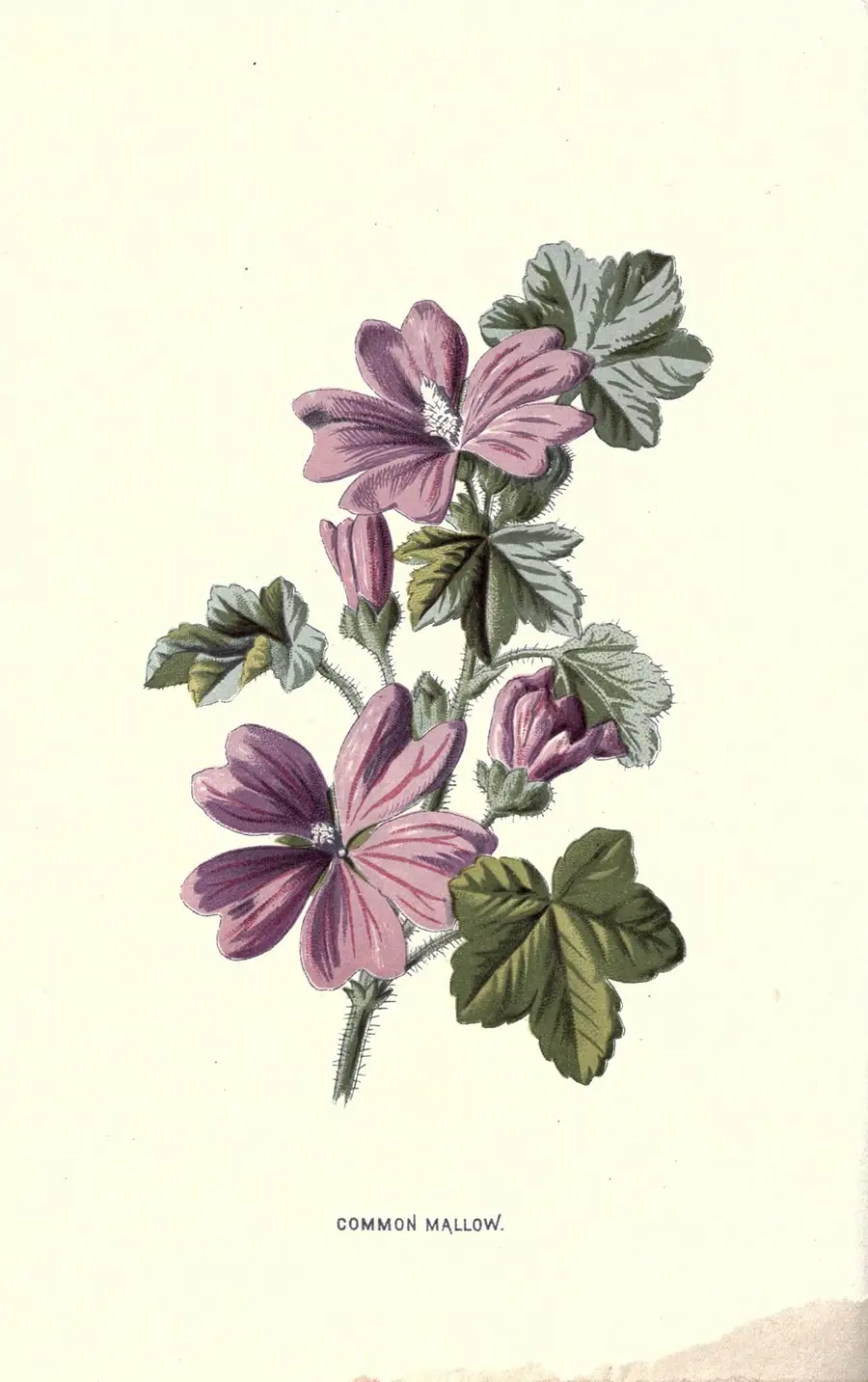
Long-stalked, roundish leaves with 5–7 shallow, toothed lobes.
Flowers
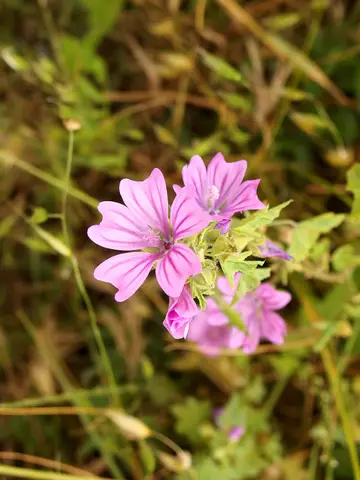
Five-petalled pinkish-purple flowers, several together in the leaf axils. The petals are notched at the tip and marked with dark purple stripes.
Fruit and seeds
A flat, round fruit made of one-seeded segments arranged in a ring; it breaks into segments when ripe.

Classification
- KingdomPlantae
- PhylumTracheophyta
- ClassMagnoliopsida
- OrderMalvales
- FamilyMalvaceae
- GenusMalva
- SpeciesMalva sylvestris
Native range
According to POWO it is native to most of Europe, around the Mediterranean, North Africa, Türkiye and western Asia east to Central Asia. It has spread as a weed in the Americas, East Asia and Australia.
Culture and history
The colour mauve
The word "mauve", a shade of purple in English and French, comes from the French name of the mallow.
Look-alikes
- Marsh mallow (Althaea officinalis): Same family, but its leaves are velvety-hairy and its flowers paler pink or white; it grows in damp places.
- Dwarf mallow (Malva neglecta): Grows flat along the ground, with much smaller, pale pink or white flowers.
Questions
How do I recognise common mallow?
By its round, hand-like lobed leaves, its five-petalled pinkish-purple flowers with dark stripes and notched tips, and its flat fruits like a small round of cheese.
Common mallow: when does it flower?
In spring and summer and autumn: May–September. Months are for temperate northern-hemisphere climates and shift with altitude and weather.
Common mallow: what is its scientific name?
Malva sylvestris L., in the genus Malva and the family Malvaceae.
Sources
- Wikipedia: Malva sylvestris
- World Flora Online
- Plants of the World Online (Kew) · native range (WCVP)
- GBIF · classification
- Wikidata
Checked: 2026-11-17. Spotted a mistake? Tell us.