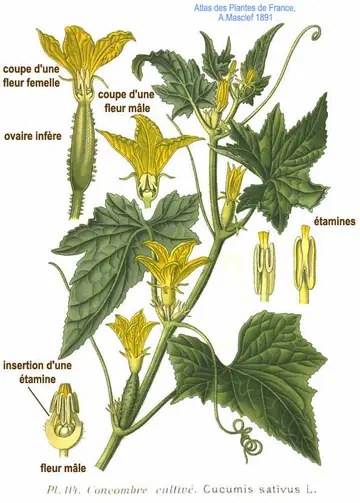
Description
Form
herbaceous climber, annual
Flower colour
White
Flowering
No reliable data in the sources.
Flowers
White flowers, which give it the name "white-flowered gourd".
Fruit and seeds
Young fruits have smooth, light green skin and white flesh. Shapes vary widely, from huge and round to small and bottle-shaped or slim and snake-like, and can exceed a metre long. Dried mature fruits have a hard, waterproof shell.
Classification
- KingdomPlantae
- PhylumTracheophyta
- ClassMagnoliopsida
- OrderCucurbitales
- FamilyCucurbitaceae
- GenusLagenaria
- SpeciesLagenaria siceraria
Native range
According to POWO it is native to tropical West, Central and East Africa, from Senegal to Nigeria, Cameroon and the Congo, Ethiopia, Somalia, Kenya and Tanzania; it is cultivated throughout the tropics.
Culture and history
One of the first containers
According to Wikipedia bottle gourds have been found at archaeological sites in China and Japan dated to about 8,000–9,000 years ago. Genetic and archaeological evidence suggests it was domesticated first in Asia and, thousands of years later, separately in Africa, and it was grown in the Americas before Columbus.
Not the calabash tree
The name is shared with the unrelated calabash tree (Crescentia cujete), whose hard fruits are also made into utensils and instruments.
Look-alikes
- Summer squash and pumpkin (Cucurbita pepo): Same family, but its flowers are large and yellow, while the calabash has white flowers. A dried calabash becomes a hard, waterproof container. Compare side by side →
Questions
Why is it called a bottle gourd?
Because the dried mature fruit has a hard, waterproof shell and has long been used as a bottle, bowl or ladle; some varieties are bottle-shaped.
Calabash: what is its scientific name?
Lagenaria siceraria (Molina) Standl., in the genus Lagenaria and the family Cucurbitaceae.
Sources
- Wikipedia: Calabash
- Plants of the World Online (Kew) · native range (WCVP)
- GBIF · classification
- Wikidata
Checked: 2026-11-23. Spotted a mistake? Tell us.