Telling them apart
Trojan fir vs English yew
Trojan fir (Abies nordmanniana subsp. equi-trojani) and English yew (Taxus baccata) look similar enough to be confused. They belong to different families: Pinaceae (pine family) and Taxaceae (yew family).
CautionEnglish yew is poisonous to people. Never pick or eat a wild plant unless you are certain of its identity. If poisoning is suspected, call your local poison centre or emergency number.

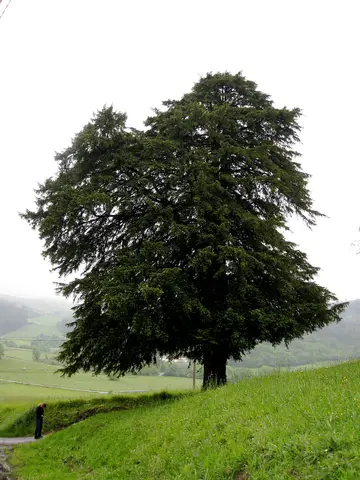
How to tell them apart
- Trojan fir: Their needles are also flat, but have two distinct white bands underneath, and they bear upright cones; yews have no cones.
Side by side
| Trojan fir | English yew | |
|---|---|---|
| Scientific name | Abies nordmanniana subsp. equi-trojani | Taxus baccata |
| Family | Pinaceae (pine family) | Taxaceae (yew family) |
| Form | tree, perennial, evergreen | tree, perennial, evergreen |
| Height | 20–30 m | 10–20 m |
| Flower colour | — | — |
| Origin | Kaz Dağları (Mount Ida), northwestern Türkiye | Europe, North Africa and western Asia |
| Toxicity | — | People: toxic · Cats: toxic · Dogs: toxic |
| Flowering | — | — |
| Leaves | Flat needles with blunt or slightly notched tips, glossy dark green above with two white stomatal bands below, brushed upwards along the shoot. | Flat needles 1–4 cm long, dark green above and paler below, arranged in two rows along the shoot. |
| Flowers | Firs do not flower; their seeds develop in cones. | Yews do not flower. Male and female trees are separate. |
| Fruit and seeds | Cylindrical cones 15–20 cm long that stand upright on the branches and break up on the tree when ripe. | On female trees a single seed is surrounded by a red, fleshy cup (aril). The aril is not toxic, but the seed inside is highly poisonous. |
All pairs: look-alike plants · Full pages: Trojan fir, English yew