Telling them apart
Hyacinth vs Muscari aucheri
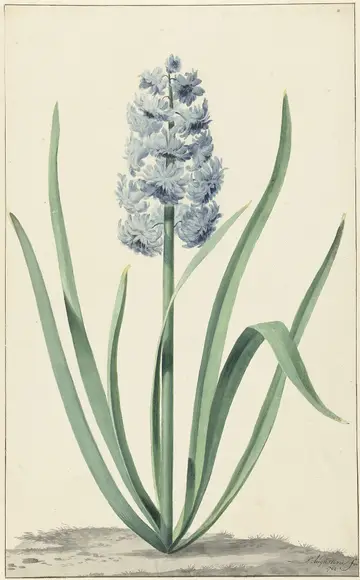
Hyacinth (Hyacinthus orientalis) and Muscari aucheri (Muscari aucheri) look similar enough to be confused. Both belong to the same family, Asparagaceae (asparagus family).
How to tell them apart
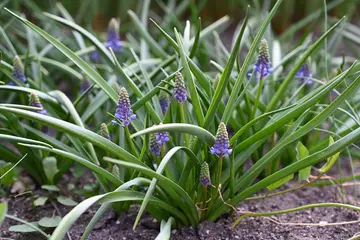
- Muscari aucheri: Much smaller, with round or urn-shaped flowers narrowed at the mouth.
Side by side
| Hyacinth | Muscari aucheri | |
|---|---|---|
| Scientific name | Hyacinthus orientalis | Muscari aucheri |
| Family | Asparagaceae (asparagus family) | Asparagaceae (asparagus family) |
| Form | herbaceous, perennial | herb (bulb), perennial |
| Height | 15–30 cm | Usually under 10 cm |
| Flower colour | Blue, Purple, Pink, White | Blue, White |
| Origin | Türkiye, Syria, Lebanon, Iraq | Türkiye |
| Toxicity | People: mildly toxic / irritant · Cats: toxic · Dogs: toxic | — |
| Flowering | — | |
| Leaves | 4–6 strap-shaped, glossy green, fleshy leaves from the bulb. | Usually two or three leaves per bulb, broad for a grape hyacinth, greyish green above with a boat-shaped, curved tip. |
| Flowers | Bell-shaped, six-lobed flowers in a dense spike on a single stalk. Wild plants have sparse, pale blue flowers; garden varieties are much denser, in blue, purple, pink, white or yellow. | A dense spike: the lower fertile flowers are bright blue with whitish teeth at the mouth, the sterile flowers at the top paler blue or whitish. |
| Fruit and seeds | A three-chambered capsule. | — |
All pairs: look-alike plants · Full pages: Hyacinth, Muscari aucheri