Telling them apart
European ash vs Common walnut
European ash (Fraxinus excelsior) and Common walnut (Juglans regia) look similar enough to be confused. They belong to different families: Oleaceae (olive family) and Juglandaceae (walnut family).
Image wanted. A licensed image will be added when found.
How to tell them apart
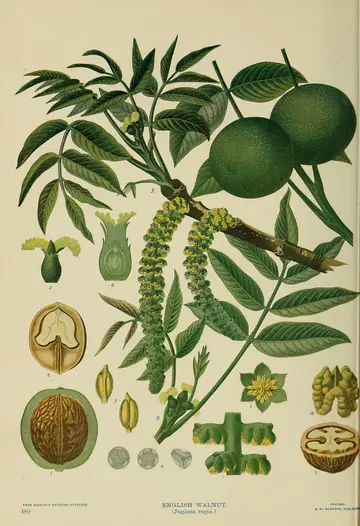
- Common walnut: Its leaves are pinnate but alternate, with fewer, larger leaflets; its buds are not black.
Side by side
| European ash | Common walnut | |
|---|---|---|
| Scientific name | Fraxinus excelsior | Juglans regia |
| Family | Oleaceae (olive family) | Juglandaceae (walnut family) |
| Form | tree, perennial, deciduous | tree, perennial, deciduous |
| Height | 20–35 m | 10–25 m |
| Flower colour | Purple | Green |
| Origin | Europe, the Caucasus and northern Anatolia | Türkiye to Central Asia |
| Toxicity | — | — |
| Flowering | ||
| Leaves | Opposite, pinnate leaves with 7–13 lance-shaped, toothed leaflets. The winter buds are velvety and jet black, which makes ash easy to recognise even in winter. | Compound leaves 20–45 cm long with 5–9 (most often 7) oval leaflets, strongly and pleasantly aromatic when crushed. |
| Flowers | Clusters of small, purplish-black flowers without petals, opening before the leaves; wind-pollinated. | Male flowers in long, hanging green catkins; female flowers 2–5 at the shoot tips, small and hairy. Wind-pollinated. |
| Fruit and seeds | Single-winged, tongue-shaped fruits (keys) in hanging bunches that stay on the tree into winter. | A hard, wrinkled nut inside a green, fleshy husk that blackens and splits when ripe; the husk stains hands brown. |
All pairs: look-alike plants · Full pages: European ash, Common walnut