Telling them apart
Dragon fruit vs Prickly pear
Dragon fruit (Selenicereus undatus) and Prickly pear (Opuntia ficus-indica) look similar enough to be confused. Both belong to the same family, Cactaceae (cactus family).
Image wanted. A licensed image will be added when found.
How to tell them apart
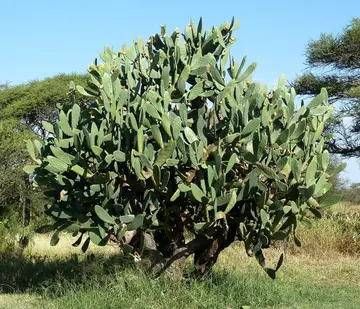
- Prickly pear: Also a cactus with edible fruit, but it does not climb: its stems are flat "pads", its yellow or orange flowers open by day, and its fruit skin carries fine bristles that lodge in the skin.
Side by side
| Dragon fruit | Prickly pear | |
|---|---|---|
| Scientific name | Selenicereus undatus | Opuntia ficus-indica |
| Family | Cactaceae (cactus family) | Cactaceae (cactus family) |
| Form | climbing cactus, perennial | succulent, perennial, evergreen |
| Height | Climbs to 10 m or more | 2–5 m |
| Flower colour | White | Yellow, Orange |
| Origin | Mexico and Central America | Mexico |
| Toxicity | Cats: non-toxic · Dogs: non-toxic | — |
| Flowering | — | |
| Leaves | Leafless; its green, fleshy, angled stems climb with aerial roots. | The true leaves are tiny and drop early. The green, flat "paddles" are stem segments (cladodes). Their dots carry stiff spines and very fine, barbed bristles (glochids) that break off easily and lodge in the skin. |
| Flowers | Giant night-opening flowers up to 35 cm across; the roughly 65 outer segments are greenish yellow or whitish. | Silky, cup-shaped yellow or orange flowers along the edges of the paddles. |
| Fruit and seeds | An oblong to oval fruit 6–12 cm long and 4–9 cm thick with red skin and large scales; the flesh is white, rarely pink, with small edible black seeds. | An egg-shaped, fleshy, sweet fruit ranging from green to red-purple; its skin carries fine bristles, so it should not be handled before peeling. |
All pairs: look-alike plants · Full pages: Dragon fruit, Prickly pear