Telling them apart
Common sorrel vs Indian knotgrass
Common sorrel (Rumex acetosa) and Indian knotgrass (Polygonum cognatum) look similar enough to be confused. Both belong to the same family, Polygonaceae (knotweed family).
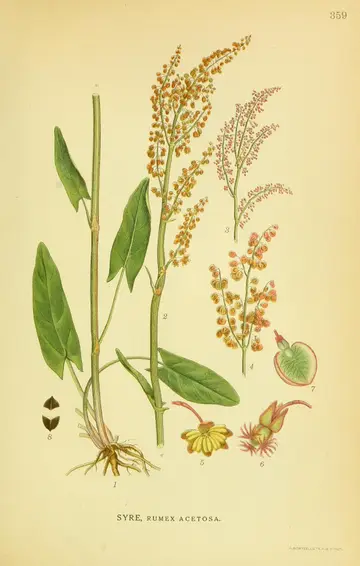
Image wanted. A licensed image will be added when found.
How to tell them apart
- Common sorrel: Same family (knotweed family), but it grows upright, its leaves are arrow-shaped with two downward-pointing lobes at the base, and its small reddish-green flowers are in branched spikes at the stem tip.
Side by side
| Common sorrel | Indian knotgrass | |
|---|---|---|
| Scientific name | Rumex acetosa | Polygonum cognatum |
| Family | Polygonaceae (knotweed family) | Polygonaceae (knotweed family) |
| Form | herbaceous, perennial | creeping herb, perennial |
| Height | 30–100 cm | Stems 15–30 cm |
| Flower colour | Red, Green | Pink |
| Origin | Europe and temperate Asia | Western and Central Asia |
| Toxicity | Cats: toxic · Dogs: toxic | — |
| Flowering | ||
| Leaves | Arrow-shaped leaves with two pointed, downward-facing lobes where the stalk joins. Stem leaves are stalkless and clasp the stem. | Leaves larger than in most other Polygonum species, green like the stems. The stems lie along the ground or rise slightly from a thick, stout rootstock. |
| Flowers | Small, reddish-green flowers in branching spikes at the stem tip; male and female flowers are on separate plants. | Pink or reddish-pink flowers 4–5 mm long, two to five together in the leaf axils. |
| Fruit and seeds | Small three-sided fruits enclosed in reddish, papery wings. | — |
All pairs: look-alike plants · Full pages: Common sorrel, Indian knotgrass