Telling them apart
Common sage vs Greek sage
Common sage (Salvia officinalis) and Greek sage (Salvia fruticosa) look similar enough to be confused. Both belong to the same family, Lamiaceae (mint family).
Image wanted. A licensed image will be added when found.
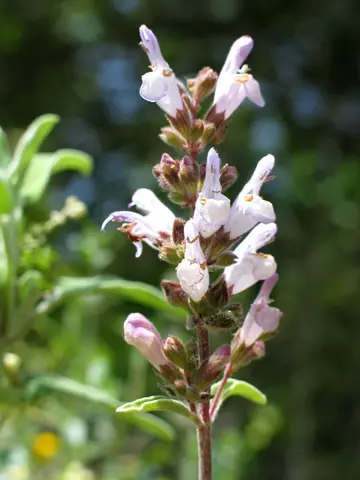
How to tell them apart
- Greek sage: The sage native to Türkiye; the whole plant is hairy and its leaves are sometimes simple, sometimes deeply three-lobed (its old name was Salvia triloba). Its flowers are pinkish lilac.
Side by side
| Common sage | Greek sage | |
|---|---|---|
| Scientific name | Salvia officinalis | Salvia fruticosa |
| Family | Lamiaceae (mint family) | Lamiaceae (mint family) |
| Form | subshrub, perennial, evergreen | shrub, perennial, evergreen |
| Height | About 60 cm | About 60 cm; flower stems rise about 30 cm above the leaves |
| Flower colour | Purple, Blue, White, Pink | Pink, Purple |
| Origin | Southern Europe | Eastern Mediterranean |
| Toxicity | Cats: non-toxic · Dogs: non-toxic | — |
| Flowering | — | |
| Leaves | Oblong, greyish-green leaves up to 6.5 cm long and 2.5 cm wide. Cultivars include purple, rose, cream and yellow variegated forms. | The whole plant is hairy. Leaves grow in clusters and are single in some places, deeply three-lobed in others, hence its old name Salvia triloba ("three-lobed sage"). |
| Flowers | Most often lavender flowers, sometimes white, pink or purple, in late spring or summer. | Pinkish-lilac flowers about 1.3 cm long in whorls along the flower stem, with small, hairy, dark reddish calyces. |
| Fruit and seeds | — | A tiny dry fruit that splits into four nutlets. |
All pairs: look-alike plants · Full pages: Common sage, Greek sage