Telling them apart
Common jasmine vs Night-blooming jasmine
Common jasmine (Jasminum officinale) and Night-blooming jasmine (Cestrum nocturnum) look similar enough to be confused. They belong to different families: Oleaceae (olive family) and Solanaceae (nightshade family).
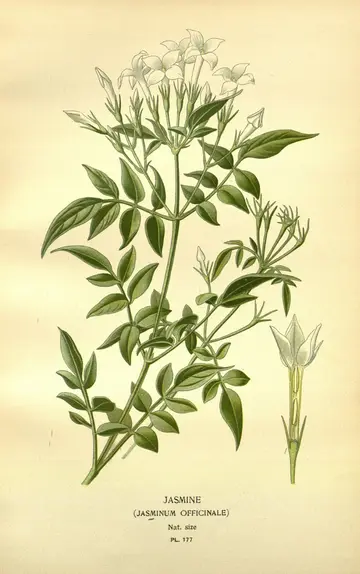
Image wanted. A licensed image will be added when found.
How to tell them apart
- Common jasmine: Similar name and an evening scent, but it belongs to the olive family, its leaves are pinnate with 5–9 leaflets and its flowers are white, five-lobed stars. Night-blooming jasmine has simple leaves and slender greenish-white tubes.
Side by side
| Common jasmine | Night-blooming jasmine | |
|---|---|---|
| Scientific name | Jasminum officinale | Cestrum nocturnum |
| Family | Oleaceae (olive family) | Solanaceae (nightshade family) |
| Form | climber, perennial, deciduous | shrub, perennial, evergreen |
| Height | Climbs several metres | Up to 4 m |
| Flower colour | White | White, Green |
| Origin | Caucasus to the Himalaya and China | Mexico and Central America |
| Toxicity | Cats: non-toxic · Dogs: non-toxic | — |
| Flowering | — | |
| Leaves | Opposite, compound leaves of 5–9 small, pointed leaflets. | Simple, narrow lance-shaped leaves 6–20 cm long and 2–4.5 cm wide, smooth, glossy and entire. |
| Flowers | White, long-tubed, five-lobed star-shaped flowers in clusters at the shoot tips; the scent is strongest in the evening. | Greenish-white flowers with a slender tube 2–2.5 cm long and five pointed lobes; they open at night and release a powerful, sweet perfume. A yellowish-flowered variety exists. |
| Fruit and seeds | A small black berry, rarely formed in cultivation. | A white berry 10 mm long and 5 mm across. |
All pairs: look-alike plants · Full pages: Common jasmine, Night-blooming jasmine