Telling them apart
Cilician fir vs English yew
Cilician fir (Abies cilicica) and English yew (Taxus baccata) look similar enough to be confused. They belong to different families: Pinaceae (pine family) and Taxaceae (yew family).
CautionEnglish yew is poisonous to people. Never pick or eat a wild plant unless you are certain of its identity. If poisoning is suspected, call your local poison centre or emergency number.

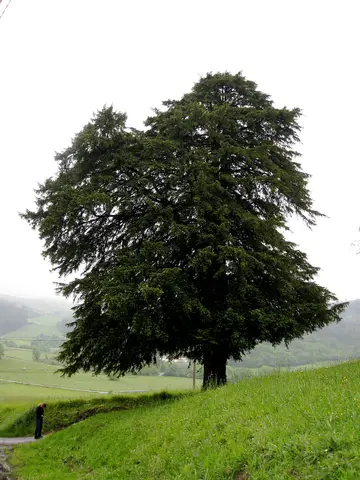
How to tell them apart
- Cilician fir: Its needles are flat too, but have two clear white bands underneath, and its large, cylindrical cones stand upright on the branches. Yew needles are pale green underneath, and instead of cones it bears single seeds in a red, fleshy cup; the seed is very poisonous.
Side by side
| Cilician fir | English yew | |
|---|---|---|
| Scientific name | Abies cilicica | Taxus baccata |
| Family | Pinaceae (pine family) | Taxaceae (yew family) |
| Form | tree, perennial, evergreen | tree, perennial, evergreen |
| Height | 20–30 m | 10–20 m |
| Flower colour | — | — |
| Origin | Taurus Mountains and Lebanon–Syria | Europe, North Africa and western Asia |
| Toxicity | — | People: toxic · Cats: toxic · Dogs: toxic |
| Flowering | — | — |
| Leaves | Flat needles with blunt or slightly notched tips and two distinct white bands underneath. | Flat needles 1–4 cm long, dark green above and paler below, arranged in two rows along the shoot. |
| Flowers | Firs do not flower; seeds develop in cones. | Yews do not flower. Male and female trees are separate. |
| Fruit and seeds | Large, cylindrical cones standing upright on the branches and breaking up on the tree when ripe. | On female trees a single seed is surrounded by a red, fleshy cup (aril). The aril is not toxic, but the seed inside is highly poisonous. |
All pairs: look-alike plants · Full pages: Cilician fir, English yew