Telling them apart
Chinese banyan vs Weeping fig
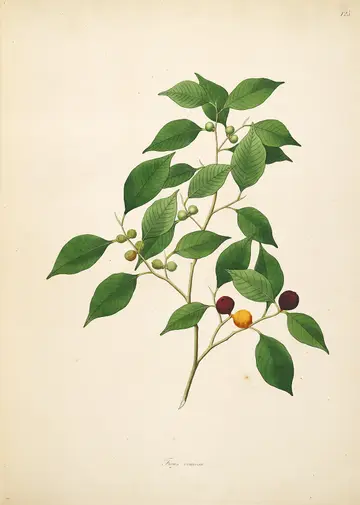
Chinese banyan (Ficus microcarpa) and Weeping fig (Ficus benjamina) look similar enough to be confused. Both belong to the same family, Moraceae (mulberry family).
Image wanted. A licensed image will be added when found.
How to tell them apart
- Weeping fig: Same genus, also with glossy oval leaves, but its leaf tips are distinctly pointed (6–13 cm) and variegated cultivars are common.
Side by side
| Chinese banyan | Weeping fig | |
|---|---|---|
| Scientific name | Ficus microcarpa | Ficus benjamina |
| Family | Moraceae (mulberry family) | Moraceae (mulberry family) |
| Form | tree, perennial, evergreen | tree, perennial, evergreen |
| Height | 25 m in the wild, occasionally 35 m | 1–3 m indoors; 30 m in the wild |
| Flower colour | — | — |
| Origin | South and Southeast Asia, Australasia | South and South-East Asia, northern Australia |
| Toxicity | — | People: mildly toxic / irritant · Cats: toxic · Dogs: toxic |
| Flowering | — | — |
| Leaves | Narrowly to broadly elliptic leaves up to 12 cm long and 9 cm wide, hairless, with 5–9 pairs of side veins that form distinct loops near the margin. | Oval, pointed, glossy leaves 6–13 cm long. Variegated cultivars (edged white or yellow) are common. |
| Flowers | Like all figs, its flowers are hidden inside a closed structure. | The flowers are hidden inside small fig-like structures; they do not form indoors. |
| Fruit and seeds | Small figs; the seeds are spread by fruit-eating birds. | Small, reddish figs; rare in cultivation. |
All pairs: look-alike plants · Full pages: Chinese banyan, Weeping fig