Telling them apart
Chia vs Greek sage
Chia (Salvia hispanica) and Greek sage (Salvia fruticosa) look similar enough to be confused. Both belong to the same family, Lamiaceae (mint family).
Image wanted. A licensed image will be added when found.
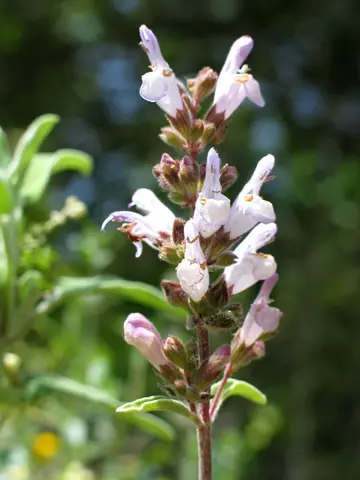
How to tell them apart
- Greek sage: Same genus (Salvia), but a hairy perennial shrub whose leaves are sometimes deeply three-lobed, with pinkish-lilac flowers in whorls along the stem.
Side by side
| Chia | Greek sage | |
|---|---|---|
| Scientific name | Salvia hispanica | Salvia fruticosa |
| Family | Lamiaceae (mint family) | Lamiaceae (mint family) |
| Form | herbaceous, annual | shrub, perennial, evergreen |
| Height | Up to 1.75 m | About 60 cm; flower stems rise about 30 cm above the leaves |
| Flower colour | Purple, White | Pink, Purple |
| Origin | Mexico and Guatemala | Eastern Mediterranean |
| Toxicity | — | — |
| Flowering | — | — |
| Leaves | Opposite leaves 4–8 cm long and 3–5 cm wide. | The whole plant is hairy. Leaves grow in clusters and are single in some places, deeply three-lobed in others, hence its old name Salvia triloba ("three-lobed sage"). |
| Flowers | Purple or white flowers in numerous clusters in a spike at the end of each stem. | Pinkish-lilac flowers about 1.3 cm long in whorls along the flower stem, with small, hairy, dark reddish calyces. |
| Fruit and seeds | Small oval seeds about 1 mm across that absorb up to 12 times their weight in liquid when soaked, developing a gel-like coating. | A tiny dry fruit that splits into four nutlets. |
All pairs: look-alike plants · Full pages: Chia, Greek sage