Telling them apart
Banana vs Bird of paradise
Banana (Musa acuminata) and Bird of paradise (Strelitzia reginae) look similar enough to be confused. They belong to different families: Musaceae (banana family) and Strelitziaceae (bird-of-paradise family).
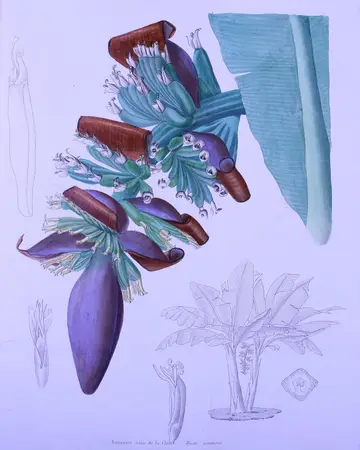
Image wanted. A licensed image will be added when found.
How to tell them apart
- Banana: Its leaves look similar, but banana leaves are much larger (2–3 m), tear easily along the veins in wind, and their sheaths wrap together into a false stem.
Side by side
| Banana | Bird of paradise | |
|---|---|---|
| Scientific name | Musa acuminata | Strelitzia reginae |
| Family | Musaceae (banana family) | Strelitziaceae (bird-of-paradise family) |
| Form | herbaceous, perennial, evergreen | herbaceous, perennial, evergreen |
| Height | 2–7 m | Up to 2 m |
| Flower colour | Purple, Yellow | Blue |
| Origin | South-east Asia | South Africa |
| Toxicity | Cats: non-toxic · Dogs: non-toxic | — |
| Flowering | — | — |
| Leaves | Very large (2–3 m), paddle-shaped leaves that tear easily along the veins in the wind. The leaf sheaths wrap around each other to form a false stem. | Large, strong leaves 25–70 cm long and 10–30 cm wide on stalks up to 1 m, arranged in two ranks to form a fan-shaped crown. |
| Flowers | A drooping flower spike emerges from the centre of the false stem; the flowers sit in rows under thick, purple-red bracts. Female flowers (which become bananas) open first, male flowers at the tip. | The flowers stand above the leaves on long stalks and emerge from a hard, beak-like sheath (spathe) held at right angles to the stem, like a bird's head and beak; it makes a sturdy perch for the sunbirds that pollinate them. |
| Fruit and seeds | Botanically a banana is a berry. Wild bananas are full of hard seeds; cultivated bananas are seedless and are propagated from suckers. | — |
All pairs: look-alike plants · Full pages: Banana, Bird of paradise