Description
Form
herbaceous (tuberous), perennial
Height: Up to 30 cm
Flower colour
WhitePinkRedPurple
Flowering
December–April
Leaves
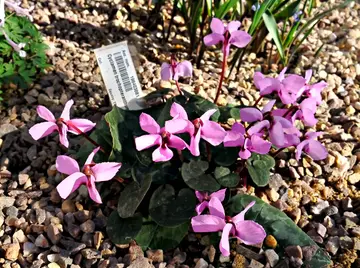
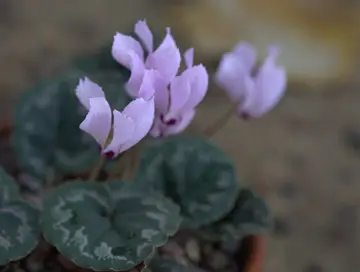
Leaves rise from the tuber; heart-shaped, fleshy, up to 14 cm, green with lighter markings above and pale green or reddish below.
Flowers
Single flowers on long stalks with five petals swept back and up; white or pale pink and lightly scented in wild plants, red, pink, purple and white in cultivars.
Fruit and seeds
A round capsule; as it ripens the stalk bends it down towards the ground without coiling.
Classification
- KingdomPlantae
- PhylumTracheophyta
- ClassMagnoliopsida
- OrderEricales
- FamilyPrimulaceae
- GenusCyclamen
- SpeciesCyclamen persicum
Native range
According to POWO it is native to Türkiye, Cyprus, the East Aegean islands, Greece, Crete, Lebanon-Syria, Palestine, Tunisia and Algeria. According to Wikipedia it grows on rocky hillsides, in shrubland and woodland up to 1,200 m.
Care
Light
Bright, indirect light.
Water
Water from below without wetting the leaves; very little during the summer rest.
Soil
Free-draining potting compost; the top of the tuber should not be buried.
Temperature
Likes a cool room (10–18 °C); fades quickly in a hot, dry room.
As in its homeland, it rests through a hot, dry summer and grows through a cool, moist winter.
Culture and history
A cyclamen not from Persia
The species name persicum means "from Persia", but according to Wikipedia the plant does not grow wild in Iran.
Toxicity
ASPCA lists cyclamens as toxic to cats, dogs and horses; the toxins are terpenoid saponins, concentrated in the tuber. Signs are drooling, vomiting and diarrhoea; eating a lot of tuber can cause heart rhythm abnormalities, seizures and death.
In an emergency call your local poison centre; for pets, contact a vet straight away. See also: plants and pets.
Look-alikes
- Cilician cyclamen: A small cyclamen endemic to the Taurus Mountains; it flowers in autumn and its flowers are smaller. Compare side by side →
- False Iberian cyclamen: Endemic to the Amanos Mountains; its flowers are magenta-purple with a dark nose. Compare side by side →
Questions
Why is my potted cyclamen wilting?
Usually because the room is too warm or the tuber has been watered from above. Cyclamen wants a cool, bright spot, watering from below and a summer rest.
Is cyclamen toxic to cats?
Yes. ASPCA lists cyclamen as toxic to cats, dogs and horses; the toxins are mostly in the tuber.
Persian cyclamen: when does it flower?
In winter and spring: December–April. Months are for temperate northern-hemisphere climates and shift with altitude and weather.
Persian cyclamen: how do you care for it?
Light: Bright, indirect light. Water: Water from below without wetting the leaves; very little during the summer rest. Soil: Free-draining potting compost; the top of the tuber should not be buried. Temperature: Likes a cool room (10–18 °C); fades quickly in a hot, dry room. As in its homeland, it rests through a hot, dry summer and grows through a cool, moist winter.
Persian cyclamen: what is its scientific name?
Cyclamen persicum Mill., in the genus Cyclamen and the family Primulaceae.
Sources
- Wikipedia: Cyclamen persicum
- ASPCA Animal Poison Control: Cyclamen
- World Flora Online
- Plants of the World Online (Kew) · native range (WCVP)
- GBIF · classification
- Wikidata
Checked: 2026-11-17. Spotted a mistake? Tell us.