Telling them apart
Black pine vs Trojan fir
Black pine (Pinus nigra) and Trojan fir (Abies nordmanniana subsp. equi-trojani) look similar enough to be confused. Both belong to the same family, Pinaceae (pine family).
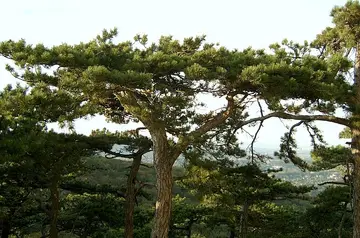

How to tell them apart
- Black pine: Grows on the same mountains, but its needles are in pairs and much longer (8–15 cm), and its cones hang down.
Side by side
| Black pine | Trojan fir | |
|---|---|---|
| Scientific name | Pinus nigra | Abies nordmanniana subsp. equi-trojani |
| Family | Pinaceae (pine family) | Pinaceae (pine family) |
| Form | tree, perennial, evergreen | tree, perennial, evergreen |
| Height | 20–55 m | 20–30 m |
| Flower colour | — | — |
| Origin | Southern Europe, Anatolia and North Africa | Kaz Dağları (Mount Ida), northwestern Türkiye |
| Toxicity | — | — |
| Flowering | — | — |
| Leaves | Needles in pairs, mostly 10–18 cm long, stiff and dark green. | Flat needles with blunt or slightly notched tips, glossy dark green above with two white stomatal bands below, brushed upwards along the shoot. |
| Flowers | Pines do not flower; in spring the male cones shed yellow pollen. | Firs do not flower; their seeds develop in cones. |
| Fruit and seeds | Egg-shaped, glossy brown cones 5–10 cm long, ripening about 18 months after pollination. | Cylindrical cones 15–20 cm long that stand upright on the branches and break up on the tree when ripe. |
All pairs: look-alike plants · Full pages: Black pine, Trojan fir